
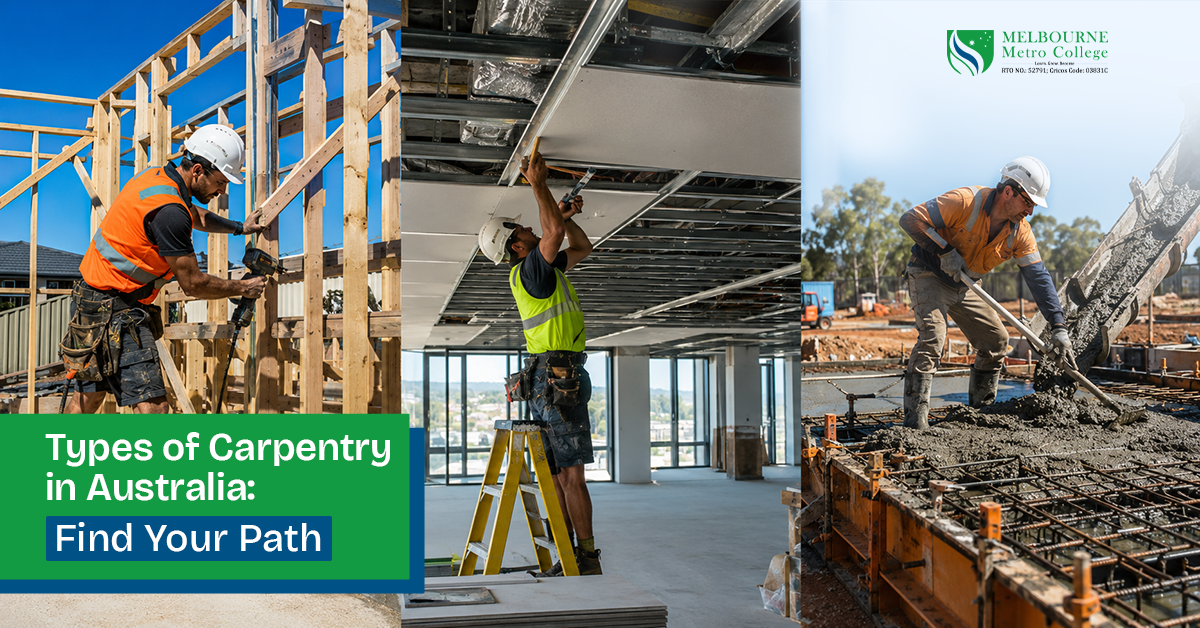
Australia employs 149,900 people across the Carpenters and Joiners occupation (Jobs and Skills Australia, February 2026). The types of carpentry in Australia span six distinct specialisations – residential, commercial, formwork, fit-out, maintenance, and heritage – each with different work environments, salary ranges, and entry requirements. Every specialisation is accessible after completingCPC30220 Certificate III in Carpentry (ANZSCO 331212), Australia’s nationally recognised trade qualification regulated by ASQA.
What Are the Main Types of Carpentry in Australia?
Australia recognises six active carpentry specialisations across residential and commercial construction sectors:
- Residential carpentry : framing and fixing for houses and townhouses
- Commercial carpentry : fit-out work in offices, hotels, and retail spaces
- Formwork carpentry : temporary concrete structures for slabs, footings, and civil projects
- Fit-out carpentry : interior partitions, suspended ceilings, and shopfitting
- Maintenance carpentry : ongoing repair and upkeep of existing structures
- Heritage carpentry : restoration of heritage-listed buildings to original specifications
Specialisation Overview Table
| Specialisation | Typical Work | Work Environment | Entry via CPC30220 | 2026 Salary Range (pre-July)* |
|---|---|---|---|---|
| Residential | Framing, roofing, sub-floors, decking | Outdoor – housing sites | Direct entry | $70,000–$90,000 |
| Commercial | Fit-out, partitions, ceilings | Indoor – commercial buildings | Direct entry | $75,000–$95,000 |
| Formwork | Concrete forms, footings, slabs | Outdoor/civil – large-scale sites | Direct entry | $85,000–$110,000+ |
| Fit-out | Shopfitting, joinery installation | Indoor – retail and office | Direct entry | $72,000–$92,000 |
| Maintenance | Repairs, renovations, facility upkeep | Mixed – residential and commercial | Direct entry | $68,000–$85,000 |
| Heritage | Restoration, period joinery, conservation | Indoor/outdoor – listed buildings | Additional experience required | $75,000–$95,000 |
*Ranges reflect Award rates prior to the 4.75% increase effective 1 July 2026. Source: Building and Construction General On-site Award 2020 (CW/ECW classifications) + Jobs and Skills Australia trend data, February 2026. Verify current rates at fairwork.gov.au.
Completion of CPC30220 does not guarantee employment, a particular salary, visa sponsorship, or any migration outcome. Career outcomes depend on individual circumstances and the labour market at time of completion. Salary ranges are indicative only, based on the Building and Construction General On-site Award 2020 and Jobs and Skills Australia data. All information current as of July 2026.
Residential Carpentry in Australia
Residential carpentry covers the construction of houses, townhouses, and multi-residential buildings. A residential carpenter performs framing and fixing across every stage of a new build.
Core tasks include:
- Setting out : marking the building footprint from structural drawings before any timber is cut
- Wall frames and roof trusses : constructing and erecting structural frames to engineering specifications
- Sub-flooring and floor systems : laying sub-floors, installing floorboards, verifying trueness
- First fix : rough carpentry before plastering, including stair stringers, door frames, and window frames
- Second fix : finish carpentry after plastering, including skirting boards, architraves, and trims
- Decking and stairs : external structures requiring precision measurement and structural knowledge
Residential carpenter salary Australia 2026
$70,000-$90,000 per year. Site allowances and overtime on active housing projects push total earnings toward the upper range.
Industry reporting suggests consistent residential framing demand across Melbourne’s western growth corridor – including suburbs such as Tarneit, Melton, Point Cook, and Sunbury – reflecting Victoria’s ongoing housing construction activity. Carpenters with strong framing skills find steady work across these areas
Commercial Carpentry in Australia
Commercial carpentry covers interior construction and fit-out work in office buildings, hotels, retail spaces, schools, and hospitals. Commercial carpenters work from structural drawings and fit-out specifications to deliver interior environments to design standard.
Core tasks include:
- Interior partitions : framing and fixing non-load-bearing wall systems
- Suspended ceilings : installing grid systems and ceiling tiles to engineering tolerances
- First fix : structural rough carpentry before walls are closed
- Second fix : finish carpentry including door furniture, trims, and joinery installation
- Shopfitting : bespoke joinery, display systems, and retail fit-out elements
- Non-timber materials : working with plasterboard, metal stud, and composite systems
Commercial carpenter salary Australia 2026
$75,000-$95,000 per year. Commercial site allowances under the Building and Construction General On-site Award 2020 consistently push commercial earnings above residential rates.
Melbourne CBD commercial fit-out demand is strong in 2026, with commercial and education projects, school upgrades, new learning facilities, commercial fit-outs, and warehouse developments creating consistent tender opportunities across the city.
Formwork Carpentry in Australia
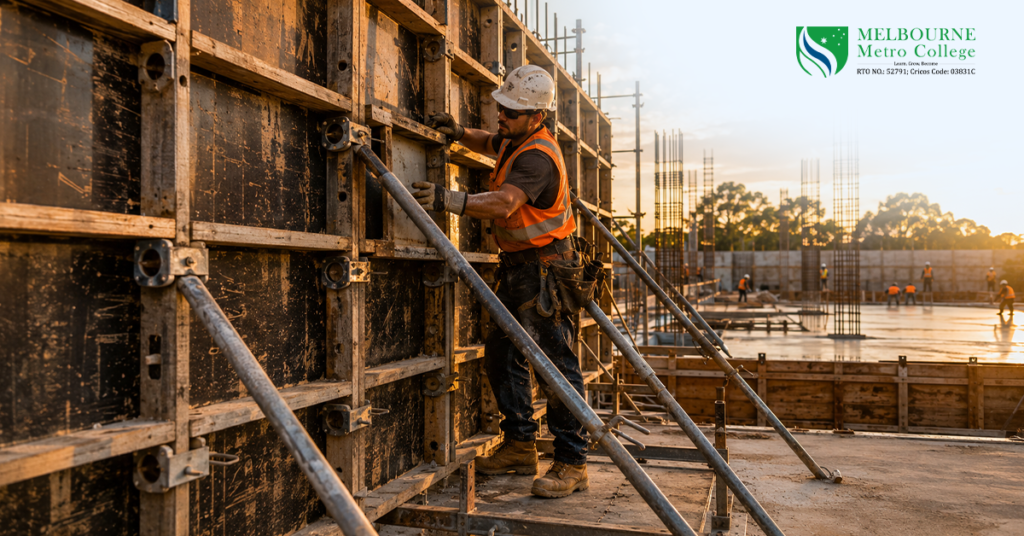
Formwork carpentry is the construction of temporary timber and engineered structures that hold concrete in place while it cures. Formwork carpenters work on residential footings, commercial slabs, bridges, tunnels, and major civil infrastructure projects.
What Is Formwork Carpentry?
Formwork carpentry is the trade specialisation that builds temporary structural forms – from timber, plywood, and proprietary systems to contain and shape poured concrete until it reaches structural strength. Formwork carpenters read structural engineer drawings, erect and strip formwork to precise tolerances, and work on both residential footings and large-scale civil construction sites.
Core tasks include:
- Reading and interpreting structural engineer drawings
- Erecting formwork for footings, slabs on ground, and elevated slabs
- Placing and fixing form panels, bracing, and proprietary systems
- Stripping and cleaning formwork after concrete achieves design strength
- Working alongside concreters on pour sequences and timing
What does a formwork carpenter do in Australia?
A formwork carpenter builds, positions, and strips the temporary structures that give concrete its shape. They work from structural drawings, apply precise tolerances on large civil and commercial sites, and coordinate with concreters and structural engineers throughout every pour.
Formwork carpenter salary Australia 2026
$85,000-$110,000+ per year. Formwork is the highest-paying carpentry specialisation in Australia. The median weekly earnings across all carpenters is $1,760 (Jobs and Skills Australia, February 2026) formwork specialists consistently earn above this median due to site complexity, physical demands, and the precision required on civil infrastructure projects.
Other Carpentry Specialisations in Australia
Maintenance carpentry covers ongoing repair, renovation, and upkeep of existing residential and commercial structures. Maintenance carpenters work across hospitals, schools, aged care facilities, and government buildings – replacing damaged elements, repairing frames, and installing new fixtures. Work is steady, year-round, and less physically intense than framing.
Heritage carpentry covers restoration and conservation of heritage-listed buildings to their original specifications. Heritage carpenters work with period timbers, traditional joinery methods, and conservation guidelines under Heritage Victoriarequirements. Melbourne’s inner suburbs – Fitzroy, Collingwood, Carlton, and Brunswick generate consistent heritage restoration demand.
Renovation carpentry bridges residential and commercial skills carpenters work on existing structures, adapting to conditions that differ from new-build environments. Strong blueprint reading and problem-solving skills are essential.
Green and sustainable carpentry uses responsibly sourced timbers, low-embodied-energy materials, and waste-minimising construction methods. This specialisation is growing as builders respond to NCC 2025 energy efficiency provisions and client sustainability expectations.
Carpenter Salary by Specialisation in Australia (2026)
Carpentry Specialisation Salary Comparison Table
| Specialisation | 2026 Salary Range (pre-July)* | Demand Level | Best Suited To |
|---|---|---|---|
| Formwork | $85,000–$110,000+ | High – Civil and commercial | Physical workers who prefer large-scale structural projects. |
| Commercial | $75,000–$95,000 | High – Melbourne CBD fit-out pipeline | Detail-oriented carpenters who prefer indoor work. |
| Heritage | $75,000–$95,000 | Moderate – Melbourne inner suburbs | Experienced carpenters with strong joinery and restoration skills. |
| Residential | $70,000–$90,000 | High – Western Melbourne growth corridor | Entry-level and framing-focused carpenters. |
| Fit-out | $72,000–$92,000 | High – Retail and office construction | Carpenters with strong second-fix and joinery skills. |
| Maintenance | $68,000–$85,000 | Stable – Facilities and aged care | Carpenters seeking variety and less physically demanding site work. |
*Ranges reflect Award rates prior to the 4.75% increase effective 1 July 2026. Source: Building and Construction General On-site Award 2020 (CW/ECW classifications) + Jobs and Skills Australia trend data, February 2026. Verify current rates at fairwork.gov.au.
Which type of carpentry pays the most in Australia?
Formwork carpentry pays the most, with experienced specialists earning $110,000+ per year on civil infrastructure and large commercial projects. Commercial carpentry is the second-highest earner, driven by site complexity allowances on Melbourne CBD fit-out projects.
Which Carpentry Specialisation Is Right for You?
These are general starting points – many students explore more than one pathway during their course. Speak with anMMC course advisor for guidance specific to your goals.
| If You Prefer... | Best Specialisation | Why | Salary Potential |
|---|---|---|---|
| Outdoor structural work, large builds, and physical challenges | Formwork or Residential Framing | Ideal for those who enjoy physically demanding, structural, and site-based construction work. | $70,000–$110,000+ |
| Indoor precision work, detailed finishing, and controlled environments | Commercial or Fit-out | Perfect for carpenters interested in second-fix work, joinery, and interior fit-outs. | $72,000–$95,000 |
| Variety, problem-solving, and working across different building types | Maintenance or Renovation | Every project is different, requiring a broad range of practical carpentry skills. | $68,000–$90,000 |
| Heritage, conservation, traditional craftsmanship, and long-term projects | Heritage | Suited to carpenters passionate about restoration, period materials, and heritage conservation standards. | $75,000–$95,000 |
Minimum award rates were increased by 4.75% from 1 July 2026 following the Fair Work Commission’s 2026 Annual Wage Review. Figures above reflect pre-July 2026 indicative ranges and should be verified against the current Fair Work Pay Calculator atfairwork.gov.au.
Figures are indicative only and do not guarantee any individual outcome, employment, or migration result. Award rates increased 4.75% from 1 July 2026 — verify current rates atfairwork.gov.au.
What type of carpenter should you become?
Match your working style to the site environment. If you prefer outdoor structural work and physical challenges, residential framing or formwork suits you. If you prefer indoor precision and controlled environments, commercial fit-out or shopfitting is the stronger path. If variety and problem-solving motivate you, maintenance and renovation carpentry offers both.
How Does CPC30220 Prepare You for Each Specialisation?

CPC30220 Certificate III in Carpentry covers34 units of competency – 27 core and 7 elective, structured to build the foundational skills every specialisation requires. The 27 core units cover WHS, blueprint reading, framing and fixing, formwork, and construction calculations. These apply across every specialisation without exception.
The 7 elective units are where specialisation begins. Students and their RTO select elective units that align with their intended career path:
- Formwork electives : footings, elevated slabs, and civil formwork systems
- Residential electives : stairs, ramps, and advanced framing systems
- Fit-out electives : linings, mouldings, partitions, and suspended ceilings
Can you specialise after completing CPC30220?
Yes. CPC30220 builds the foundation for all six specialisations. Students choose elective units that align with their intended path during study. After completing CPC30220, carpenters deepen their specialisation through on-site experience, leading-hand roles, and further study. CPC40120 Certificate IV in Building and Construction is the natural progression for carpenters moving into supervisory or site management roles.
For the full unit list and elective packaging rules, read the CPC30220 International Student Guide at MMC.
Study Carpentry Specialisations in Melbourne at MMC
Melbourne Metro College (MMC) delivers CPC30220 Certificate III in Carpentry across campus:
- Classroom: Level 5, 440 Elizabeth Street, Melbourne CBD VIC 3000
- Workshop: 101 Davies Avenue, Sunshine North VIC 3020
| Detail | Information |
|---|---|
| RTO Number | 52791 |
| CRICOS Provider Code | 03831C |
| Duration | 52 weeks (40 weeks of training + 12 weeks of scheduled holidays) |
| Weekly Attendance | 20 hours of supervised training and assessment |
| Additional Study | Approximately 10 hours of independent self-study per week |
| Delivery Mode | Classroom-based theory (Melbourne CBD) combined with practical workshop training in Sunshine North |
MMC is an ASQA-regulated RTO delivering CPC30220 under the CPC Construction, Plumbing and Services Training Package, aligned to the National Construction Code (NCC). All practical training takes place in a real or closely simulated workplace environment.
Frequently Asked Questions About Types of Carpentry in Australia
What are the main types of carpentry in Australia?
The six main types of carpentry in Australia are residential, commercial, formwork, fit-out, maintenance, and heritage carpentry. Each specialisation covers different work environments – from outdoor residential framing to indoor commercial fit-out and large-scale civil formwork. All six are accessible after completing CPC30220 Certificate III in Carpentry.
What is formwork carpentry?
Formwork carpentry is the trade specialisation that builds temporary structural forms to contain and shape poured concrete. Formwork carpenters erect and strip timber and proprietary form systems on residential footings, commercial slabs, and civil infrastructure projects, working from structural engineer drawings to precise tolerances.
What is the difference between residential and commercial carpentry?
Residential carpentry covers outdoor framing and fixing of houses and townhouses wall frames, roof trusses, sub-flooring, and finish carpentry. Commercial carpentry covers indoor fit-out work in offices, hotels, and retail spaces – interior partitions, suspended ceilings, shopfitting, and joinery installation. Commercial carpenters typically earn more due to site complexity allowances under the Building and Construction General On-site Award 2020.
Which type of carpentry pays the most in Australia?
Formwork carpentry pays the most in Australia, with experienced specialists earning $85,000-$110,000+ per year. Commercial carpentry is second, at $75,000-$95,000, driven by site complexity allowances on Melbourne CBD fit-out projects. The median weekly earnings across all carpenters is $1,760, according toJobs and Skills Australia (February 2026).
What type of carpenter should I become?
Match your choice to your working style. Choose residential framing or formwork if you prefer outdoor structural work and physical challenges. Choose commercial or fit-out carpentry if you prefer indoor precision and controlled environments. Choose maintenance carpentry if you want variety across different building types without the physical intensity of framing.
Can I specialise after completing CPC30220?
Yes. CPC30220’s 7 elective units allow students to choose a specialisation direction during study. After completing the qualification, carpenters deepen their specialisation through on-site experience and leading-hand roles. CPC40120 Certificate IV in Building and Construction is the next formal qualification for carpenters moving into supervisory and site management roles.
Is formwork carpentry hard?
Formwork carpentry is physically demanding and requires precise structural knowledge – carpenters work with heavy form systems, read structural engineer drawings, and operate on large civil and commercial sites. CPC30220 includes dedicated formwork units that build this competency progressively. No prior formwork experience is required to start the qualification.
Which carpentry specialisation is best for international students in Australia?
The right specialisation depends on your interests and career goals rather than student status. Residential and commercial fit-out electives are commonly chosen by students seeking broad, transferable skills, as they build on core CPC30220 units without requiring additional post-qualification experience. Speak with MMC’s course advisors about which electives suit your goals. Course completion does not guarantee employment or amigration outcome.
Ready to Choose Your Carpentry Specialisation in Melbourne?
Also read:
- All Posts
- Carpentry Courses Australia
- Disability Support Australia
- Early Childhood Education
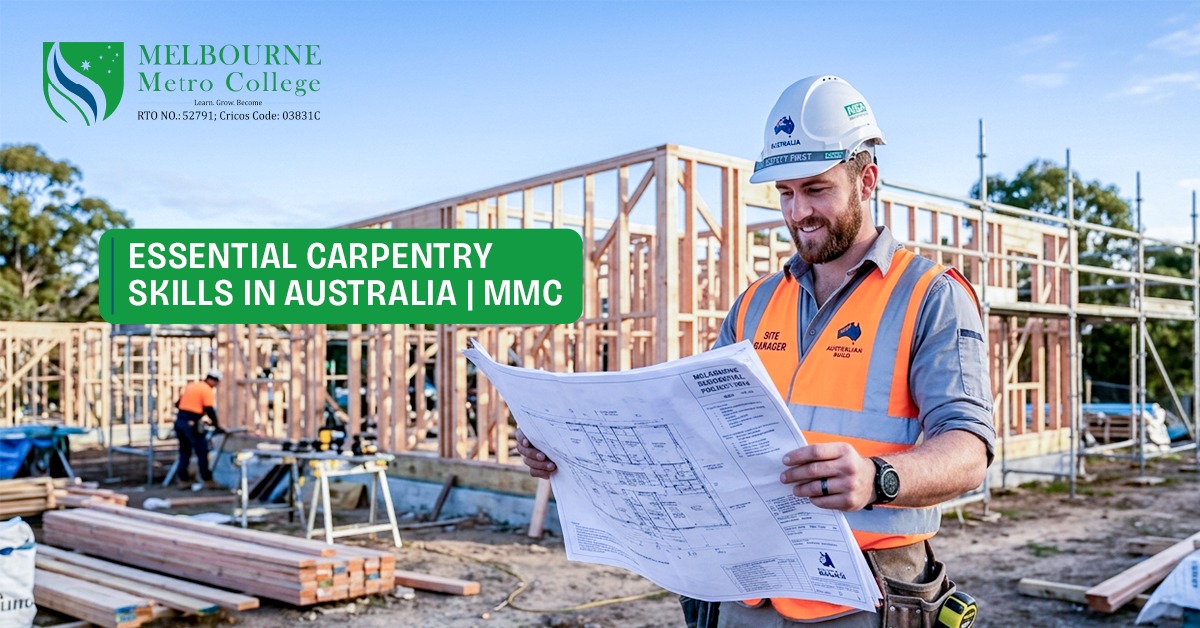
New to carpentry? Learn the essential skills Australian builders expect - timber framing, WHS, blueprint reading - all covered in...
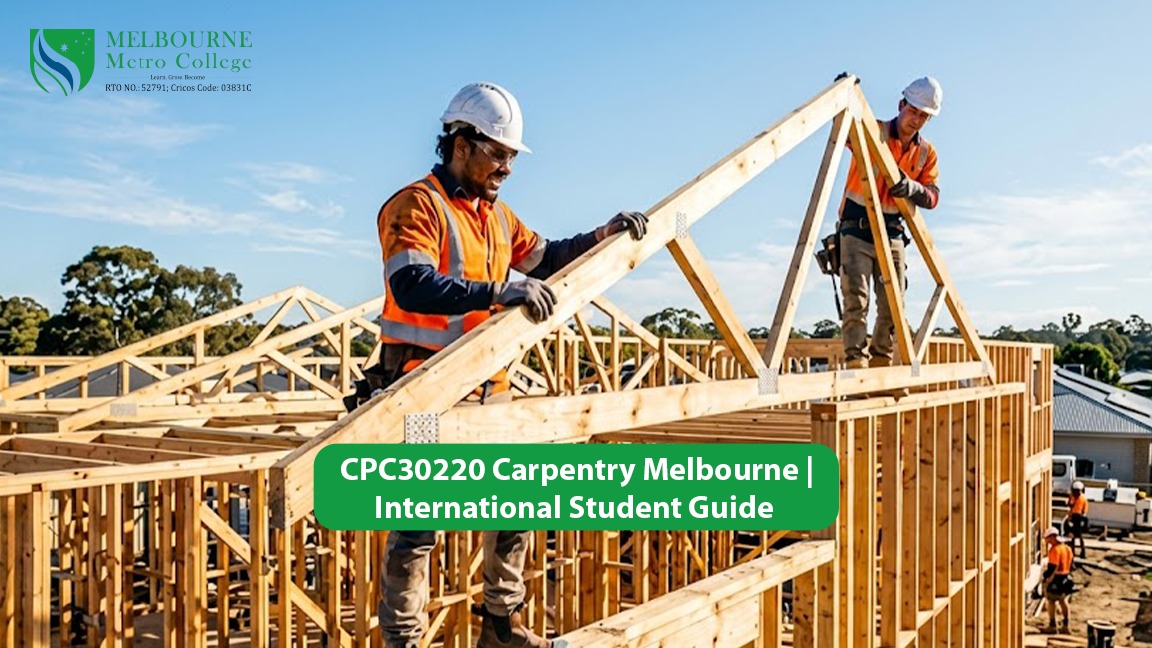
CPC30220 Certificate III in Carpentry entry requirements, salary data, and why international students choose Melbourne. Enrol at MMC today.
Salary ranges are indicative only, based on the Building and Construction General On-site Award 2020 and Jobs and Skills Australia data, and do not guarantee any individual outcome, employment, salary, sponsorship, or migration result. Career outcomes depend on individual circumstances and the labour market at the time of completion. All information current as of July 2026.
Melbourne Metro College | RTO: 52791 | CRICOS: 03831C | Level 5, 440 Elizabeth Street, Melbourne CBD VIC 3000 | melmc.edu.au
