
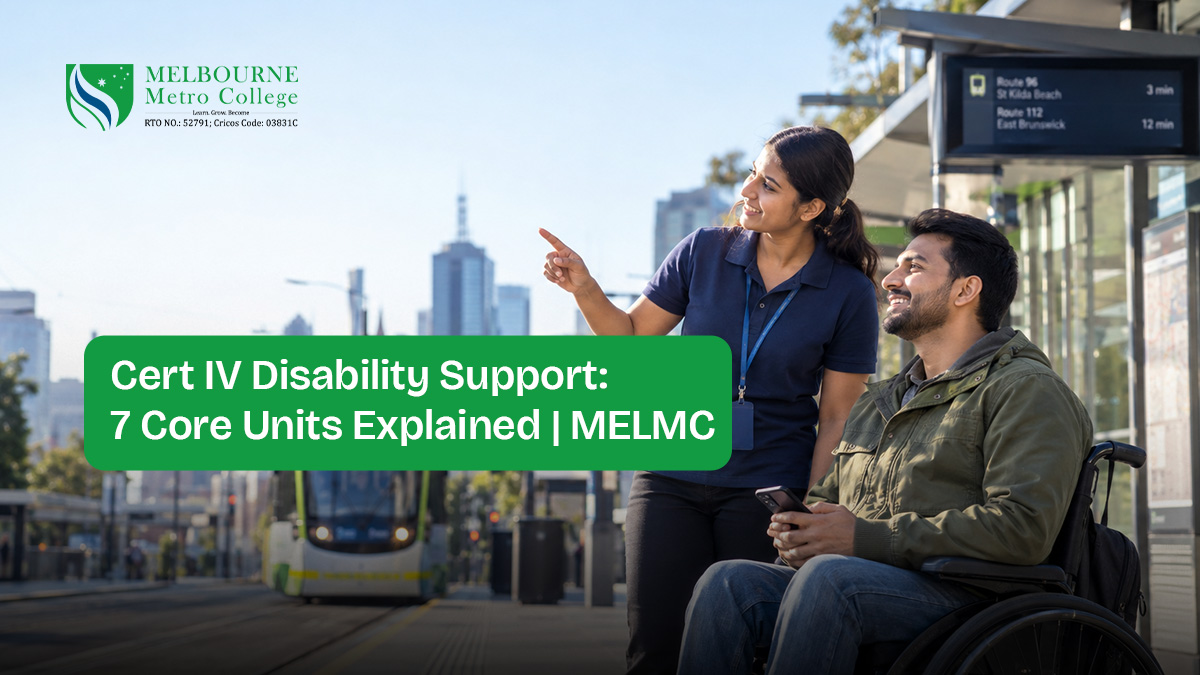
The CHC43121 Certificate IV in Disability Support has10 units: 7 core units that every provider must deliver, plus 3 electives. The seven core units cover person-centred behaviour supports, community participation, skills development, complex needs, legal and ethical compliance, mental health and work health and safety. Five are about the person you support. Two are about the framework you work within.
This guide explains each core unit in plain English, with examples of what it looks like on shift. It is written for people studying in Melbourne, including international students. If you’re still deciding whether the course suits you, start with our guide to CHC43121 and whether the Certificate IV in Disability Support is right for you.
Cert IV Disability Support units at a glance
Unit code
Unit title
What it builds
CHCCCS044
Follow established person-centred behaviour supports
Following behaviour support plans safely and lawfully
CHCDIS017
Facilitate community participation and social inclusion
Opening doors to community life
CHCDIS018
Facilitate ongoing skills development using a person-centred approach
Building independence at the person’s pace
CHCDIS019
Provide person-centred services to people with disability with complex needs
Safe support when several needs interact
CHCMHS001
Work with people with mental health issues
Responding supportively to mental health needs
CHCLEG003
Manage legal and ethical compliance
Duty of care, rights, reporting, privacy
HLTWHS003
Maintain work health and safety
Keeping yourself and others safe
Unit codes and titles are listed on the national register, training.gov.au.
What is the CHC43121 Certificate IV in Disability Support?
CHC43121 is a nationally recognisedAQF Level 4 qualification. It prepares you to support people with disabilities in their homes and in community settings. In this role youwork without direct supervision, contribute to an individualised support plan, and may coordinate a small team.
It sits one step above the Certificate III in Individual Support (Disability). Cert III trains you to follow a plan. Cert IV trains you to make more of the decisions around that plan, handle more complex situations and lead others. For a full side-by-side breakdown, read our comparison of Certificate III vs Certificate IV in disability support.
Before you enrol: what international students should know
There is a national entry requirement. The qualification requires completion of one of the following:
- CHC33021 Certificate III in Individual Support (Disability)
- CHC33015 Certificate III in Individual Support (Disability)
- CHC30408 Certificate III in Disability, plus the CHCSS00125Entry to Certificate IV in Disability Support skill set
Not sure whether your existing study counts? Our guide explains whether you need a Cert III before Cert IV in disability support, including credit transfer and recognition of prior learning. If you don’t hold an accepted qualification yet, MELMC’s Certificate III in Individual Support (CHC33021) is the usual starting point.
Other things to check:
- CRICOS registration. Student visa holders must study a course registered for international students. At Melbourne Metro College (MELMC), CHC43121 carries CRICOS course code 113679B. Not every provider is registered for this course, so always check the CRICOS register.
- English and LLN. Providers assess language, literacy and numeracy before you start. MELMC uses an ACSF-mapped assessment and offers extra support if you need it. See our entry requirements for the current English levels.
- Compliance checks. For placement you typically need a National Police Record Check, a Working with Children Check and up-to-date immunisation records. Disability work also commonly requires an NDIS Worker Screening Check. It is an assessment, carried out by the Worker Screening Unit in the state or territory where you apply, of whether a person working with people with disability poses a risk to them. You can read the official explanation on the NDIS Quality and Safeguards Commission website. Apply early, as processing times vary. ndiscommission
- Work rights. Student visa holders can work up to 48 hours per fortnight while their course is in session, with different rules during scheduled breaks. Always confirm your own conditions through the Study Australia student visa guide or the Department of Home Affairs, because MELMC staff cannot give migration advice. studyaustralia
For fees, duration and intake details, see MELMC’s fees and charges page.
The 7 core units explained
1. CHCCCS044: Follow established person-centred behaviour supports
In short: you learn to work within a behaviour support plan exactly as written, safely, lawfully and respectfully.
You’ll learn to:
- Read and understand a behaviour support plan and the reasons behind it
- Recognise triggers, early warning signs and the person’s communication style
- Use proactive, preventive strategies before a situation escalates
- Respond calmly to behaviours of concern within the plan
- Understand regulated and restrictive practices, and why you may only follow what is authorised
- Document and report incidents accurately and take part in debriefs
Illustrative example: a participant becomes distressed in a noisy shopping centre. You recognise the early signs from the plan, reduce sensory input, offer the agreed communication tool and record what happened afterwards.
A common misunderstanding: this unit teaches you tofollow a plan, not write one. Behaviour support plans are developed by qualified behaviour support practitioners. Your role is to apply them consistently and report what you observe.
How it’s assessed: typically written questions and scenario-based or simulated tasks. Confirm the method with your provider.
Careers it supports: behaviour support assistant, senior disability support worker.
2. CHCDIS017: Facilitate community participation and social inclusion
In short: you help people take part in community life on their own terms.
You’ll learn to:
- Work with the person to identify their interests, goals and the barriers in their way
- Find and approach community activities, groups and services
- Support the person to build and keep social connections
- Adapt environments and activities so they are accessible
- Review whether participation is working, and change the approach if it isn’t
Illustrative example: a participant wants to join a community choir. You explore options with them, contact a local group, attend the first sessions together and gradually step back as their confidence grows.
Why it matters: inclusion is a core goal of the NDIS. Employers value workers who can open doors, not just provide care. Our guide to the skills disability support workers need in Australia shows how this fits with other core abilities.
Careers it supports: community access coordinator, lifestyle support officer, community engagement facilitator.
3. CHCDIS018: Facilitate ongoing skills development using a person-centred approach
In short: you help people build practical skills and independence, at their own pace and toward their own goals.
You’ll learn to:
- Identify the skills a person wants to develop, such as cooking, travel training or money management
- Break tasks into manageable steps
- Choose teaching approaches that suit how the person learns
- Give encouragement and feedback that builds confidence
- Monitor progress and adjust goals
Illustrative example: a participant wants to catch the tram independently. Over several weeks you practise the route together, then reduce your involvement step by step, checking in after each trip.
Placement link: providers often tie this unit to workplace evidence, so you demonstrate skills development with a real participant.
Careers it supports: lifestyle support officer, social educator, day program worker.
4. CHCDIS019: Provide person-centred services to people with disability with complex needs
In short: this is the signature unit of the qualification. It prepares you to support people whose needs overlap, such as physical, intellectual, sensory, communication and health needs together.
You’ll learn to:
- Work with the person, their family and other professionals to understand all of their needs
- Plan support that coordinates different providers and avoids gaps
- Recognise when a situation is beyond your scope and escalate
- Communicate effectively with people who communicate in different ways
- Review support regularly as needs change
On shift, this looks like: a participant has cerebral palsy, uses a communication device and has a health condition requiring monitoring. You coordinate with their therapist and family, follow the health plan within your scope and make sure their preferences still lead the day.
Why employers care: senior roles go to people who can handle complexity calmly and know their limits.
Careers it supports: senior disability support worker, residential support worker, team leader.
5. CHCMHS001: Work with people with mental health issues
In short: you learn to recognise and respond to mental health needs, including when they appear alongside disability.
You’ll learn to:
- Understand common mental health conditions and how they affect daily life
- Use a recovery-oriented approach that respects the person’s strengths and choices
- Communicate respectfully and reduce stigma
- Respond to distress or crisis and know when to seek help
- Look after your own wellbeing
Illustrative example: a participant becomes withdrawn and stops eating regularly. You notice the change, talk with them in a way that suits their communication, raise it with the team and support access to appropriate help.
Why it matters: many people with disability also experience psychosocial or mental health challenges. Support workers are often the first to notice changes.
Careers it supports: behavioural support roles, community and mental health support roles.
6. CHCLEG003: Manage legal and ethical compliance
In short: you learn the rules and principles that protect participants and you.
You’ll learn to:
- Identify the laws, standards and codes your work must follow
- Applyduty of care, balanced withdignity of risk, a person’s right to take reasonable risks
- Protect privacy and confidentiality
- Recognise and report suspected abuse, neglect or exploitation
- Handle ethical dilemmas and conflicts of interest
- Contribute to quality improvement and complaints processes
Illustrative example: a participant wants to cook independently and you are concerned about the hot stove. You work through a risk assessment together to find an approach that respects their choice and manages the danger, rather than simply saying no.
Melbourne context: NDIS providers operate under the NDIS Practice Standards and Code of Conduct, overseen by the NDIS Quality and Safeguards Commission. For a practical overview of what employers expect, see our guide to NDIS support worker requirements in Australia.
Careers it supports: every senior role, especially team leader and support coordination roles.
7. HLTWHS003: Maintain work health and safety
In short: you learn to keep workplaces safe, as a contributor and monitor, not only a rule-follower.
You’ll learn to:
- Follow and help improve work health and safety (WHS) policies and procedures
- Identify hazards and help assess and control risks
- Handle manual handling, infection control and incident reporting safely
- Take part in consultation with colleagues about safety
- Contribute to safe systems in community and home settings
Illustrative example: a participant’s home has a loose rug near the bathroom. You flag it, help put a control in place and record it, because a home is both a person’s private space and your workplace.
Local context: in Victoria, workplace safety is regulated by WorkSafe Victoria, and the term OHS is common.
Careers it supports: all roles, and a stepping stone to supervisory duties
How the seven units work together
On a single shift you might support a participant with complex needs (CHCDIS019) to practise a morning routine (CHCDIS018), go to a community event (CHCDIS017) and manage a stressful moment using their behaviour support plan (CHCCCS044). You may notice a change in their mood (CHCMHS001), keep their information private (CHCLEG003) and spot a safety hazard on the way (HLTWHS003).
That overlap is why employers value the Cert IV. You can see the whole picture and act on it.
Electives
In addition to the seven core units, you complete three electives chosen from the qualification’s elective list. Electives vary by provider and can cover topics such as leadership, rights and advocacy, first aid or reporting abuse. Check the CHC43121 course page for the exact electives you will study.
Placement and assessment
Assessment typically combines written work, scenario or simulation tasks and workplace evidence. Placement hours differ between providers, so confirm the hours and how placement is arranged before you enrol. MELMC explains how placements are organised on its work placement page.
Careers and pathways after Cert IV
Graduates move into roles such as:
- Senior disability support worker
- Disability support team leader
- Behavioural support officer
- Lifestyle support officer
- Community engagement facilitator
- NDIS support coordinator (with experience and further training)
If you’re mapping the full route from entry level, our guide on how to become a disability support worker in Australia walks through each step. For further study, the Diploma of Community Services (CHC52025) is a common next step toward case management and coordination roles.
Frequently Asked Questions
How many units are in the Cert IV in Disability Support?
Ten: seven core units and three electives. All providers deliver the same seven core units. Electives vary.
What are the 7 core units of CHC43121?
CHCCCS044 (behaviour supports), CHCDIS017 (community participation), CHCDIS018 (skills development), CHCDIS019 (complex needs), CHCLEG003 (legal and ethical compliance), CHCMHS001 (mental health) and HLTWHS003 (work health and safety).
Do I need a Certificate III first?
Yes. The national qualification requires CHC33021 or CHC33015 Certificate III in Individual Support (Disability), or CHC30408 plus the CHCSS00125 skill set. Read more in our guide on whether you need a Cert III before Cert IV.
Can international students study the Cert IV in Disability Support in Melbourne?
Yes, at providers registered on CRICOS for the course. MELMC’s course code is 113679B. Not all Melbourne providers accept international students into this course.
Is there a work placement?
It depends on the provider. Hours vary across Australia, so confirm the figure and how placement is arranged before enrolling.
What is the difference between Cert III and Cert IV in Disability Support?
Cert III prepares you to deliver support by following a plan. Cert IV prepares you to work with more autonomy, manage complexity and lead others. See the full Certificate III vs Certificate IV comparison.
Is the qualification the same across Australia?
Yes. It is a nationally recognised qualification, and the core units are the same everywhere.
Does completing the Cert IV guarantee a visa or job?
No. A qualification supports your application but does not guarantee any visa or employment outcome. Check current requirements with the Department of Home Affairs.
Ready to take the next step?
See fees, intakes and placement details on the CHC43121 Certificate IV in Disability Support page, apply online, or speak to our admissions team.
Disclaimer : Information is current as of 7 October 2026 and may change. See the fees page and course page for current details.
