
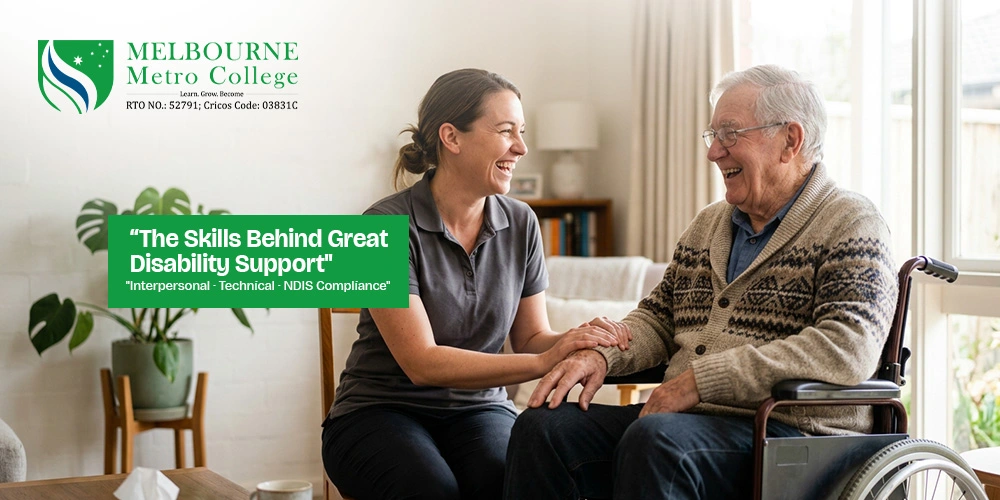
Quick Answer: Disability support workers in Australia need three categories of skills:
- Interpersonal skills — communication, empathy, patience, adaptability, cultural competency
- Technical skills — manual handling, medication support, behaviour support, first aid, documentation
- Compliance skills — NDIS Code of Conduct, Duty of Care, Dignity of Risk, worker screening
Employers expect all three together. Soft skills alone are not considered sufficient for professional roles.
Key Takeaways
- Disability support worker skills fall into three groups: interpersonal, technical and NDIS compliance.
- Communication, empathy, patience and adaptability are the interpersonal skills employers ask about most often.
- Technical skills such as manual handling, medication support and documentation are trained, not innate.
- Balancing Duty of Care with Dignity of Risk is one of the more advanced compliance skills in the sector.
- CHC33021 Certificate III in Individual Support (Disability) is a common entry pathway; CHC43121 Certificate IV in Disability Support can support progression toward supervisory-style roles, depending on individual performance and employer demand.
- International students can study disability support qualifications in Melbourne through CRICOS-registered providers, and the course structure is designed to meet CRICOS course-hours requirements for a student visa.
Table of Contents
- What Does a Disability Support Worker Do in Australia?
- The 3 Skill Categories at a Glance
- Core Interpersonal Skills for Disability Support Workers
- Technical and Practical Skills
- Legal, Ethical and NDIS Compliance Skills
- Certificate III vs Certificate IV: Which Skills Do You Need?
- How to Build These Skills: Training Pathways in Australia
- Frequently Asked Questions
What Does a Disability Support Worker Do in Australia?
A disability support worker helps people with disability carry out daily activities, work toward their personal goals and take part in community life, while respecting their right to make their own choices.
Typical duties include:
- Personal care support (dressing, bathing, grooming, medication assistance)
- Household support (meal preparation, housekeeping, budgeting help)
- Community participation (outings, appointments, social and recreational activities)
- Transport to appointments, activities or public transport assistance
- Emotional support and companionship
- Skill development toward independence (cooking, budgeting, using public transport)
Workforce snapshot (Source: Jobs and Skills Australia, OSCA 422231):
|
Metric |
Figure |
|
National workforce size |
~151,400 workers |
|
Gender split |
70.5% female / 29.5% male |
|
Employment type |
33.9% full-time / 66.1% part-time |
|
Median age |
40 years |
|
Victoria’s share of the workforce |
~22.8% |
|
Main employing industry |
Health Care and Social Assistance |
As the NDIS has matured, “being kind” is no longer treated as sufficient on its own — providers now expect a working combination of interpersonal ability, practical competence and compliance knowledge.
The 3 Skill Categories at a Glance
Skill Category | Examples | Why It Matters | Where You Build It |
Interpersonal (soft) skills | Communication, active listening, empathy, patience, adaptability, cultural competency | Builds trust and makes support genuinely person-centred | Life experience + CHC33021 core units |
Technical (hard) skills | Manual handling, medication support, behaviour support, first aid, documentation | Keeps participants and workers physically safe | CHC33021 & CHC43121 practical placement |
Compliance skills | NDIS Code of Conduct, Duty of Care, Dignity of Risk, worker screening | Protects participants’ rights and keeps the worker legally accountable | CHC43121 (CHCLEG003 – Manage legal and ethical compliance, a core unit) |
Core Interpersonal Skills for Disability Support Workers
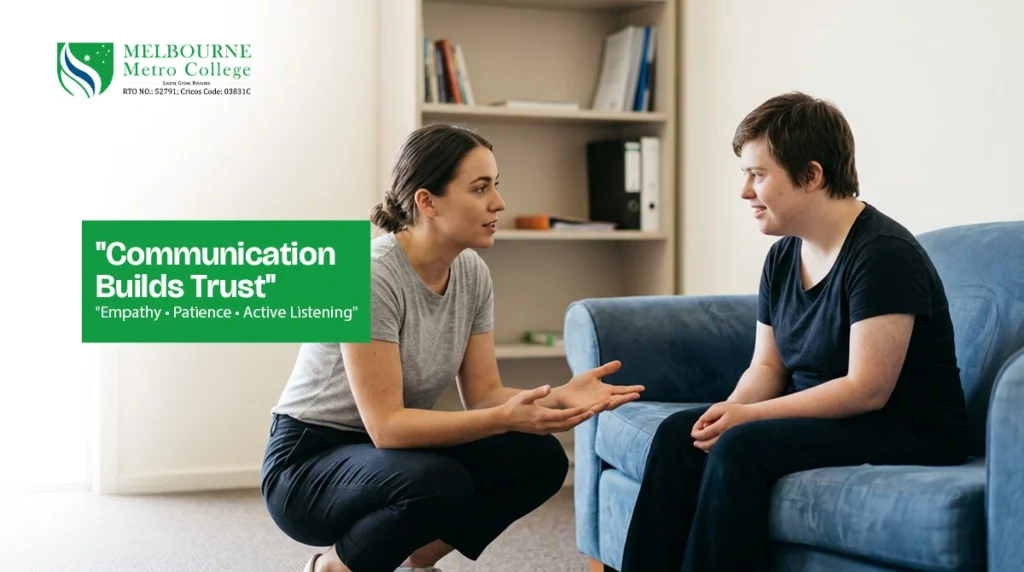
Interpersonal skills are what most job ads mention first — they’re what participants and families notice immediately, and what turns routine support into support that builds trust.
Communication and Active Listening
- Reading non-verbal cues (body language, expression, tone) as closely as spoken words
- Adapting communication style for non-verbal clients or those with cognitive disability
- Using short, jargon-free sentences without talking down to the person
- Noticing when body language doesn’t match what’s being said, and adjusting accordingly
Empathy and Professional Boundaries
- Understanding what a participant is feeling and responding with genuine care
- Keeping a professional boundary rather than becoming a “friend” — protects both worker and participant
- Building resilience to process difficult moments (grief, distress, frustration) without carrying them home
- Recognising early signs of burnout in yourself
Patience and Adaptability
- Letting a participant complete a task in their own time rather than stepping in to speed it up
- Adjusting a planned activity when someone is having a harder day than expected
- Staying calm when routines are disrupted by unexpected events
Cultural Competency
- Understanding how a participant’s cultural or religious background shapes their preferences
- Respecting dietary requirements, family involvement in decisions, and gender preferences for support
- Adjusting your approach rather than applying one method to everyone — especially relevant in Melbourne’s highly multicultural client base
Types of Technical and Practical Skills : Hard Skills
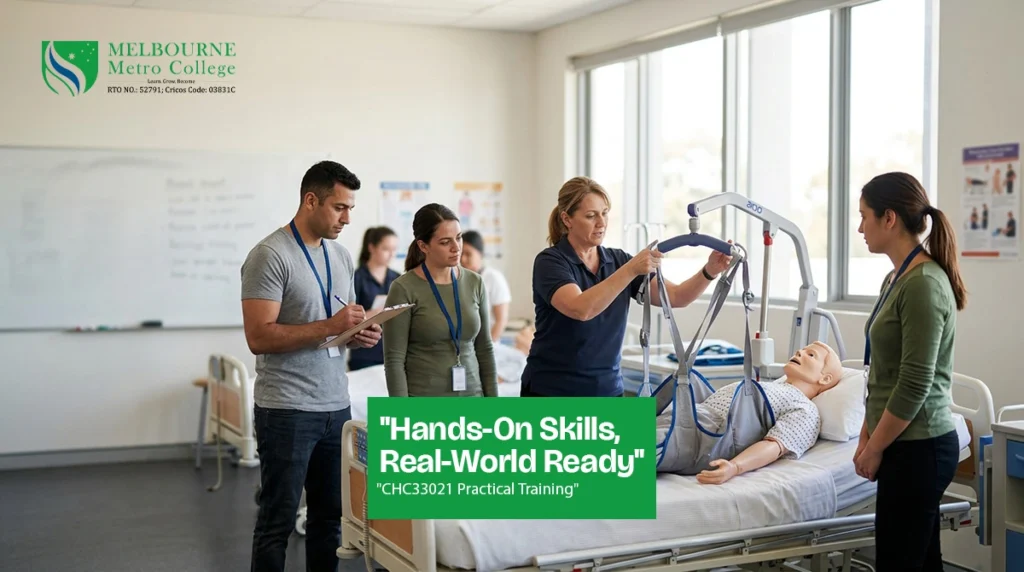
These are the trainable, demonstrable competencies that keep support safe and effective — most closely tied to formal qualifications rather than personality.
- Personal care & manual handling — safe transfer techniques, correct use of hoists and slide sheets, dignity-preserving personal care
- Medication support & health monitoring — managing schedules, recording observations, knowing when to escalate to a health professional
- Behaviour support — following an individualised, person-centred plan (mapped to unit CHCCCS044, a core unit in CHC43121) rather than a generic script
- First aid, CPR & infection control — current HLTAID011 certification, PPE use, hygiene protocols in home and community settings
- Documentation & NDIS reporting — clear, factual progress notes and incident reports that protect participant privacy and hold up under review
Legal, Ethical and NDIS Compliance Skills
This is an area some competitors content under-covers — but a worker who is warm and capable without understanding their legal obligations can still put a participant at risk.
NDIS Code of Conduct — key obligations:
- Respect a participant’s right to self-determination and decision-making
- Protect their privacy
- Provide services safely and competently
- Act with honesty and integrity
- Take reasonable steps to prevent and respond to violence, exploitation, neglect and abuse
Duty of Care vs Dignity of Risk
|
Principle |
What It Means |
Example |
|
Duty of Care |
The worker’s responsibility to keep the participant safe |
Stepping in if a task poses a genuine safety risk |
|
Dignity of Risk |
The participant’s right to make their own choices and take reasonable personal risks |
Supporting someone to try a new activity even if it involves some risk |
Good support workers learn to hold both principles at once, rather than defaulting to overprotection.
Compliance checks generally required in Victoria:
- NDIS Worker Screening Check (for risk-assessed roles)
- National Police Check
- Working with Children Check (where relevant)
Certificate III vs Certificate IV: Which Skills Do You Need?
CHC33021 Certificate III in Individual Support (Disability) | CHC43121 Certificate IV in Disability Support | |
Skill focus | Direct, supervised support delivered under an individualised plan | Leadership, complex needs, legal/ethical compliance |
Career paths graduates may pursue* | Support worker, personal care assistant | Team leader, NDIS coordinator, behavioural support officer |
Key units | Person-centred support fundamentals | CHCLEG003 (core – legal/ethical compliance); leadership electives such as BSBLDR411 may be selected depending on the RTO’s elective mix |
Best for | Career changers, first entry into the sector | Workers ready to build toward supervising a small team |
*Career paths listed are indicative only. Completing a qualification does not guarantee a particular job outcome — employment depends on individual performance, work placement experience, and employer demand at the time of graduation, all of which are outside the provider’s control.
How to Build These Skills: Training Pathways in Australia
Natural aptitude helps, and formal training is designed to build these skills into a demonstrable, employable skill set that most NDIS-registered providers now expect to see. Completing a course does not by itself guarantee employment; outcomes depend on individual performance, placement experience and employer demand.
- CHC33021 Certificate III in Individual Support (Disability) — a common entry point, built around supervised person-centred support with substantial work placement. See our full guide: How to Become a Disability Support Worker in Australia
- CHC43121 Certificate IV in Disability Support — extends your skills into leadership, complex needs support and compliance management, and may support progression toward supervisory or coordination roles. Explore the course: CHC43121 Certificate IV in Disability Support or read CHC43121 Explained
- For international students — disability support qualifications are available through CRICOS-registered providers such as Melbourne Metro College. Course structures, including work placement hours, are designed to meet CRICOS course-hours requirements for a student visa. Melbourne Metro College is not a registered migration agent and does not provide immigration or visa advice; for guidance on visa conditions or migration outcomes, please consult a registered migration agent or the Department of Home Affairs.]
Frequently Asked Questions
What are the most important skills for a disability support worker in Australia?
The most important skills combine interpersonal ability (communication, empathy, patience, adaptability) with technical competence (manual handling, medication support, documentation) and NDIS compliance knowledge (Code of Conduct, Duty of Care, Dignity of Risk). Employers generally look for all three together, not soft skills alone.
Do you need a qualification to become a disability support worker?
Not for every entry-level role, but most registered NDIS providers prefer or require a Certificate III in Individual Support (Disability) such as CHC33021. A Certificate IV such as CHC43121 can support progression toward supervisory roles, subject to individual performance and employer requirements.
What is the difference between soft skills and technical skills in disability support?
Soft skills are interpersonal qualities like communication, empathy and patience that build trust with participants. Technical skills are practical, trainable competencies like manual handling, medication assistance and documentation. Both are required — soft skills alone are not considered sufficient for professional roles.
What is Dignity of Risk in disability support work?
Dignity of Risk is the principle that people with disability have the right to make their own choices and take reasonable personal risks, balanced against a worker’s Duty of Care to keep them safe. Learning to balance these two is considered one of the more advanced skills in the sector.
Can you become a disability support worker with no experience?
Yes. Many people enter the sector without direct disability-sector experience, using training such as CHC33021 Certificate III in Individual Support combined with supervised work placement to build foundational skills before their first paid role.
What checks do disability support workers need in Victoria?
Workers in NDIS risk-assessed roles generally need an NDIS Worker Screening Check, along with a National Police Check and, in some settings, a Working with Children Check. Requirements vary by employer and role.
How long does it take to build disability support worker skills?
There’s no single timeframe — it depends on whether you complete formal training (such as CHC43121 or a shorter CHC33021), the required work placement hours, and your existing transferable experience from other people-facing roles.
Can international students study disability support courses in Melbourne?
Yes. CRICOS-registered providers such as Melbourne Metro College offer disability support qualifications to international students, with course structures designed to meet CRICOS course-hours requirements for a student visa. Students seeking advice on visa conditions or migration matters should consult a registered migration agent.
What is the difference between a Certificate III and Certificate IV in disability support?
Certificate III (CHC33021) prepares workers for direct, supervised support roles. Certificate IV (CHC43121) builds on this with leadership, complex needs support and legal/ethical compliance skills, and may support progression toward team leader or coordinator roles, depending on individual performance and employer demand.
Start Building Your Disability Support Skills in Melbourne
Whether you’re starting from scratch or ready to build toward a leadership role, the right qualification is designed to build these skills into a demonstrable, employable skill set — though individual outcomes will depend on your own performance, placement experience and employer demand.
- Explore CHC33021 Certificate III in Individual Support to begin
- Explore CHC43121 Certificate IV in Disability Support if you’re ready to build toward supervising and leading a team
- Apply now or get in touch with our admissions team to find the right starting point for you
About this provider
Melbourne Metro College | RTO Code: 52791 | CRICOS Provider Code: 03831C
