
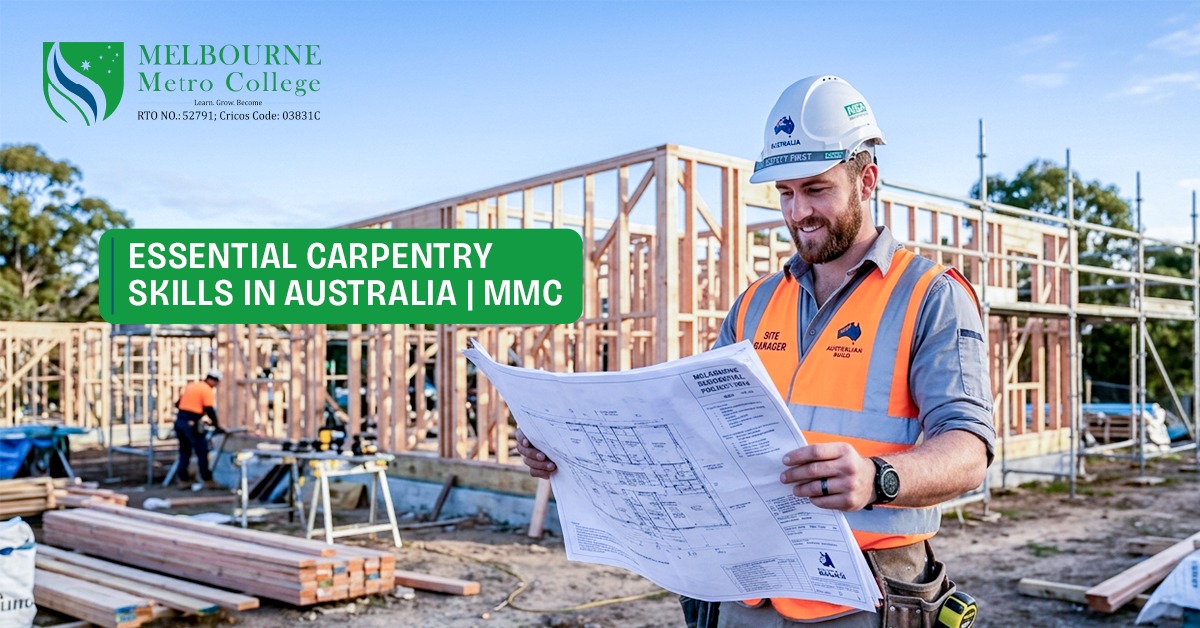
Thinking about becoming a carpenter in Australia? The first thing to know is that carpentry here isn’t just about working with wood. It’s a trade built on a specific set of skills that every employer, builder, and site supervisor expects you to demonstrate before you start.
This guide covers the essential carpentry skills the Australian trade demands, what CPC30220 Certificate III in Carpentry teaches you, and how to build these skills atMelbourne Metro College (MMC) in Melbourne CBD.
What Skills Do You Need to Be a Carpenter in Australia?
To work as a carpenter in Australia, you need three categories of skills working together:
| Skill Category | What It Covers | Why It Matters |
|---|---|---|
| Technical skills | Blueprint reading, timber framing, formwork, hand and power tools, precision measurement, WHS | Foundation of every task on a residential or commercial job site |
| Physical skills | Strength, stamina, manual dexterity, hand-eye coordination, fitness for outdoor conditions | Required to sustain a full working day safely on the tools |
| Soft skills | Attention to detail, problem solving, time management, teamwork, communication | Determines quality of output and reliability on site |
Technical Carpentry Skills Every Australian Carpenter Needs
Technical skills are the foundation of the trade. In practice, this means blueprint literacy, confident tool competency, and the precision to measure and cut materials to specification every time. Without these, no carpenter can work safely or productively on an Australian job site.
Blueprint Reading and Plan Interpretation
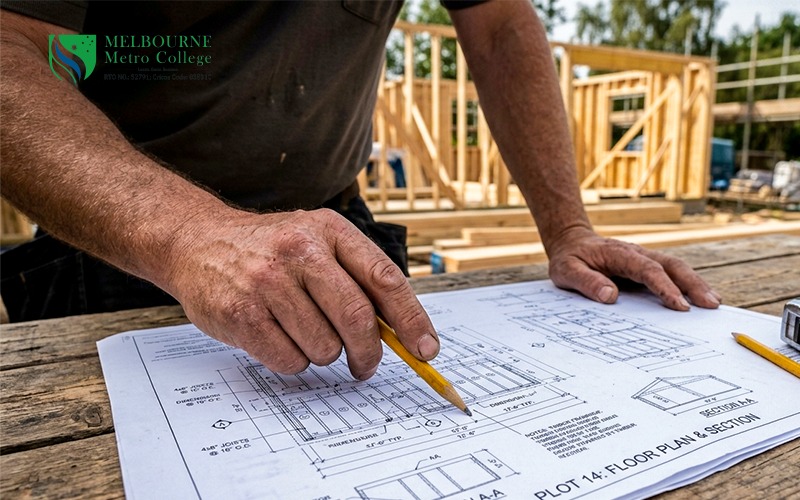
Every job on a residential or commercial site starts with a set of drawings. A carpenter who cannot read and interpret construction plans, specifications, and dimensions cannot set out a building correctly. Errors at this stage flow through every phase of construction – and fixing them is expensive.
You need to be able to:
- Read architectural and structural drawings to extract dimensions and installation sequences
- Interpret specifications to select correct materials, timbers, and fixings
- Prepare layouts from drawings before cutting or framing begins
- Identify discrepancies between drawings and on-site conditions and flag them to the site supervisor
Blueprint reading is formally assessed across multiple units in CPC30220, includingCPCCCA3025 – Read and Interpret Plans, Specifications and Drawings for Carpentry Workat MMC.
Timber Framing, Floor and Wall Construction
Structural carpentry – framing and fixing – is the largest single skill block in the trade. This covers:
- Floor framing:laying sub-flooring, installing floorboards, verifying trueness of structures
- Wall framing:constructing and erecting wall frames to specification, including non-timber systems
- Ceiling framing:constructing ceiling frames and installing ceiling linings
- Roof structures:erecting roof trusses and constructing pitched roofs, nailing fascia panels and sheathing roofs
- Exterior cladding:fitting exterior wall cladding, window frames, and door frames
Setting out is the foundation of all structural work – measuring and marking the building footprint and framing positions from the plans before any material is cut. A mistake in setting out affects every structure built above it.
Hand Tools, Power Tools and Precision Measurement
Hand tools and power tools are central to every working day in carpentry – from circular saws, nail guns, and impact drivers on structural framing tasks, to chisels, hand planes, and hand saws for precision fit-out and finishing work. A competent carpenter uses both categories confidently and safely across every phase of a construction project.
You work daily with:
- Measuring tapes, levels, squares, and chalk lines
- Circular saws, mitre saws, jigsaws, and reciprocating saws
- Nail guns, drills, and impact drivers
- Hand saws, chisels, and planes for fine fit-out work
Measurement errors in carpentry are not minor inconveniences – they create structural problems, waste materials, and generate costly rework on site. Precision is a professional standard, not a personal preference, and every unit in CPC30220 reinforces accurate measurement as a core competency.
Work Health and Safety on Site
WHS is not a box-ticking exercise in Australian construction – it is a legal requirement. Before you step onto any job site or into a training workshop in Australia, you must hold aWhite Card (CPCWHS1001 – Prepare to Work Safely in the Construction Industry).
WHS skills a carpenter needs include:
- Identifying site hazards and applying appropriate risk controls
- Working safely at heights and using fall protection systems
- Conducting and participating in site safety inductions
- Understanding legislative and regulatory requirements under the relevant state WHS Act
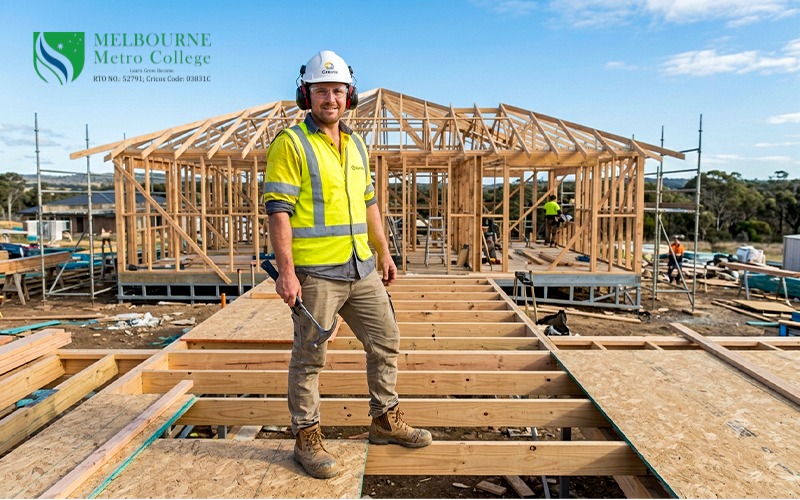
- Using personal protective equipment correctly – safety footwear, eye protection, ear protection, and overalls
For a full breakdown of WHS requirements and the White Card process, read theCPC30220 International Student Guide
Physical and Soft Skills the Trade Demands
Carpentry is a physically active trade. A typical day on the tools includes lifting heavy framing materials, working in outdoor conditions across all seasons, holding positions at height or at ground level for extended periods, and maintaining focus through a full eight-hour shift. Physical fitness and stamina are daily job requirements that directly affect your safety and output on site.
- Physical fitness:Sustained standing, heavy lifting, and working in variable weather conditions across a full working day
- Manual dexterity and hand-eye coordination:Essential when operating hand tools, power tools, and fitting precision components
- Attention to detail:Precision in measurement, accurate setting out, and care when fitting windows, doors, and trims directly determines the quality of the finished structure. Detail errors on commercial sites require costly rectification
- Problem solving:Construction sites present daily challenges – materials that do not match drawings, structural conditions that differ from the plan, and sequencing conflicts between trades
- Time management:Carpenters work alongside electricians, plumbers, painters, and other tradespeople. Poor time management causes delays across the entire project
- Teamwork and communication:Clear communication with your crew and site supervisor keeps the project on schedule and prevents sequencing conflicts between trades
- Adaptability:Conditions on residential sites differ significantly from commercial sites. Experienced carpenters move between both with confidence
Do Carpenters Need Maths in Australia?
Yes – but not advanced mathematics. Every carpenter in Australia uses maths on the job every working day. Calculating material quantities for flooring and cladding requires area and volume. Setting out roof pitches and stair stringers requires applied geometry. You do not need advanced mathematics – but you do need practical number confidence, and CPC30220 builds this through dedicated construction calculation units from the first week of training.
The maths carpenters use daily:
- Measurement and fractions –converting between millimetres, centimetres, and metres accurately
- Geometry –calculating angles for roof pitches, stair stringers, and raked ceilings
- Area and volume –estimating material quantities for flooring, cladding, and concrete
- Basic arithmetic –adding, subtracting, multiplying, and dividing for material orders and cost calculations
What Does CPC30220 Certificate III in Carpentry Teach You?
CPC30220 is structured to build every skill category above – systematically, through competency-based training in a real or closely simulated workplace environment. It covers34 units of competency: 27 core and 7 elective.
Here is how the qualification maps to the skills the trade demands:
| Skill the Trade Demands | What CPC30220 Teaches |
|---|---|
| Blueprint reading | Interpret plans, specifications, and drawings - CPCCCA3025 |
| Timber framing | Construct wall frames, ceiling frames, roof trusses, sub-floors |
| Formwork | Erect and dismantle formwork for footings and ground slabs |
| First and second fix | Install windows, doors, linings, mouldings, and trims |
| WHS and White Card | CPCWHS1001 - completed before practical training begins |
| Precision measurement | Construction calculations across all structural and fix-out units |
| Physical site work | All practical units conducted on-site or in a simulated workplace |
Learn Carpentry Skills in Melbourne at MMC
Melbourne Metro College (MMC) delivers CPC30220 Certificate III in Carpentry from its Melbourne CBD campus at Level 5, 440 Elizabeth Street – accessible by train, tram, and bus from all Melbourne suburbs.
MMC delivers CPC30220 through classroom and workshop-based training across two campuses. Theory and knowledge units are delivered in the classroom at Level 5, 440 Elizabeth Street, Melbourne CBD. Practical and hands-on training takes place at the workshop facility at 101 Davies Avenue, Sunshine North VIC 3020. Students attend 20 hours of supervised training and assessment per week, with an additional 10 hours of unsupervised self-study expected outside of class. Trainers bring current, verified Australian building industry experience to every practical session. All training and assessment takes place in a real or closely simulated workplace environment aligned withNational Construction Code (NCC) requirements.
| Detail | Information |
|---|---|
| RTO Number | 52791 |
| CRICOS Provider Code | 03831C |
| CRICOS Course Code | 120738D |
| Classroom Campus | Level 5, 440 Elizabeth St, Melbourne CBD VIC 3000 |
| Workshop Campus | 101 Davies Avenue, Sunshine North VIC 3020 |
| Duration | 52 weeks (40 weeks training + 12 weeks holidays) |
| Training Structure | 4 terms of 10 weeks each |
| Weekly Attendance | 20 hours supervised training per week |
| Additional Study | ~10 hours unsupervised study per week |
Frequently Asked Questions About Carpentry Skills in Australia
The most important carpentry skills in Australia are blueprint reading, timber framing, precision measurement, hand and power tool competency, and WHS compliance including a valid White Card. These core technical skills are formally assessed across the 34 units of CPC30220 Certificate III in Carpentry — Australia's nationally recognised trade qualification.
Carpentry is a structured, learnable trade with no prior experience required. CPC30220 builds skills progressively - WHS and basic tool use first, then framing, fix-out, and finishing. Students advance by demonstrating each competency at their own pace, not on a fixed timeline. Most beginners find the hands-on, practical format easier to engage with than classroom-only study.
Yes — but not advanced maths. Carpenters use practical measurement, basic geometry, area, volume, and arithmetic on every working day. CPC30220 includes dedicated construction calculation units that build these skills from the ground up, regardless of your prior maths background.
CPC30220 covers 34 units of competency across WHS and White Card, blueprint reading, timber framing, formwork, first and second fix fit-out, and construction calculations. All training takes place in a real or closely simulated workplace, building skills across both residential and commercial carpentry.
Graduates work as qualified carpenters on residential and commercial construction sites or subcontract independently. Further study options include CPC40120 Certificate IV in Building and Construction and CPC50220 Diploma of Building and Construction — the entry pathway toward a builder's licence in most Australian states.
No. CPC30220 is the nationally recognised qualification awarded at the end of a carpentry apprenticeship — but it can also be completed through a full-time course at a CRICOS-registered RTO without an employer-sponsored contract, making it accessible to students who cannot secure an apprenticeship placement.
Ready to Build Your Carpentry Skills in Melbourne?
Melbourne Metro College delivers CPC30220 Certificate III in Carpentry from Melbourne CBD – 52 weeks full-time — classroom theory at Melbourne CBD and hands-on practical training at Sunshine North, with qualified industry trainers.
Apply Now at MMC or contact the admissions team to ask about intake dates, fees, and entry requirements.
Melbourne Metro College | RTO: 52791 | CRICOS: 03831C | Level 5, 440 Elizabeth Street, Melbourne VIC 3000 | melmc.edu.au
Completion of CPC30220 does not guarantee employment, a particular salary, visa sponsorship, or any migration outcome. Career outcomes depend on individual circumstances and the labour market at time of completion. All information is current as of June 2026.
