
How to Become a Disability Support Worker in Melbourne
Start your career in Melbourne as a Disability Support Worker. Get the 2026 guide, NDIS clearance, and training requirements to begin your journey.
Certificate III vs IV in Aged Care – Which Path Fits You?

Compare Certificate III vs IV in Aged Care — career outcomes, duration and entry requirements. Study aged care courses in Melbourne at Melbourne Metro College.
Diploma vs Certificate III in Early Childhood Education
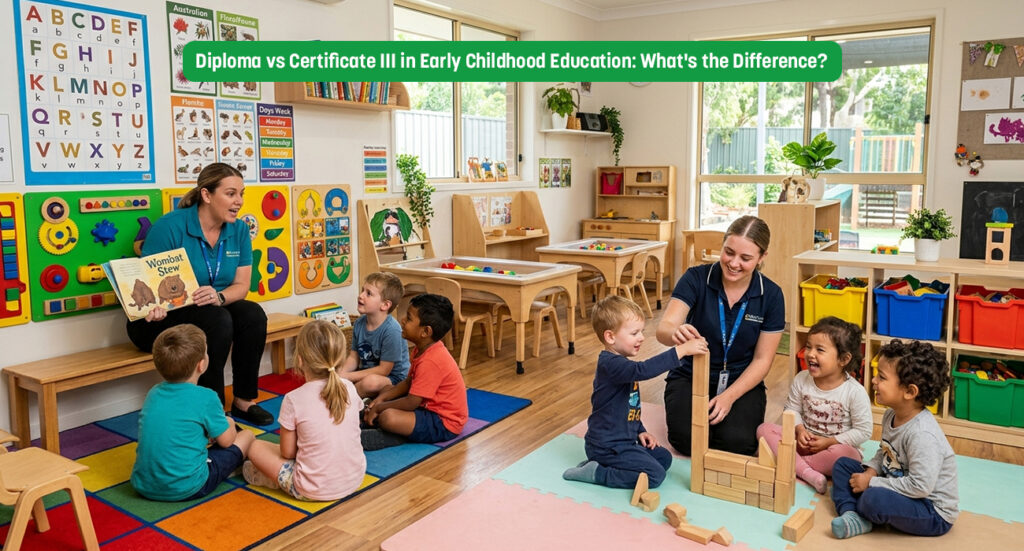
Diploma vs Certificate III in Early Childhood Education: What’s the Difference? If you are considering a career working with children in Australia, two qualifications stand out: the CHC30125 Certificate III in Early Childhood Education and Care and the CHC50125 Diploma of Early Childhood Education and Care. Both are nationally recognised under the Australian Qualifications Framework (AQF) and are required under the National Quality Framework (NQF) to work in regulated childcare services in Australia. Choosing between them depends on your career goals, current experience, and how quickly you want to enter the workforce. At Melbourne Metro College (RTO 52791), we offer both qualifications from our Melbourne CBD campus — giving students a clear, supported pathway from entry-level childcare work through to leadership roles in early childhood education and care. Why Early Childhood Education Is One of Australia’s Most In-Demand Careers Australia’s early childhood education sector is growing at a rate few industries can match. The Australian Government’s continued investment in childcare subsidies and regulated early learning services has created sustained, long-term demand for qualified early childhood educators across the country — and Melbourne is no exception. Here is why a career in early childhood education and care makes sense in 2025–2026: Job security: Qualified childcare workers are in short supply nationally. Early childhood educators are listed on Australia’s Skills Priority List, meaning trained professionals are actively needed across every state and territory. Meaningful work: Early childhood educators lay the foundation for children’s lifelong cognitive, social, and emotional development. You are not simply supervising playtime — you are shaping young minds during the most critical developmental window of a child’s life. Flexible work options: Roles across long day care, family day care, preschool, and outside school hours care (OSHC) offer part-time, casual, and full-time schedules to suit different lifestyles. Clear career progression: The sector offers a structured pathway — from entry-level childcare assistant roles (Certificate III) through to lead educator, educational leader, and centre director positions (Diploma and beyond). Diploma vs Certificate III in Early Childhood Education: At-a-Glance Comparison Feature Certificate III (CHC30125) Diploma (CHC50125) AQF Level Level 3 Level 5 Ideal for Beginners, career changers Those with Cert III or sector experience Duration at MMC 6–12 months 12–24 months Entry requirements Basic literacy and numeracy — no prior qualifications required Certificate III or concurrent enrolment Work placement hours Minimum 120 hours Minimum 280 hours Typical job roles Childcare Assistant, Early Childhood Educator, Family Day Care Educator Lead Educator, Educational Leader, Centre Director, Nominated Supervisor Career pathway Leads to Diploma Leads to Bachelor of Education / Early Childhood Teaching Government funding (VIC) Eligible (Skills First) Eligible (Skills First) Both qualifications are nationally recognised under Australia’s AQF and are mandated under the National Quality Framework (NQF) for staffing compliance in regulated children’s education and care services. What Is the Certificate III in Early Childhood Education and Care (CHC30125)? The Certificate III in Early Childhood Education and Care (CHC30125) is considered an entry‑level qualification for individuals seeking to work in regulated children’s education and care services. Purpose of the Qualification This qualification reflects the role of educators who: Work under guidance or supervision Support children’s learning, wellbeing, and development Assist with the implementation of an approved learning framework Follow established policies and procedures within early childhood settings Graduates may work in a range of regulated education and care services, including: Long day care centres Family day care services Kindergartens or preschools Entry Pathway There are no formal prerequisite qualifications for enrolment in CHC30125. Suitability is determined through pre‑training review processes, including language, literacy, and numeracy (LLN) assessment. Employment Outcomes (Indicative Only) Completion of this qualification may support employment in roles such as: Early Childhood Educator Assistant Educator Employment outcomes depend on individual circumstances, employer requirements, and regulatory conditions. This qualification does not guarantee employment. Enquire about CHC30125 Certificate III at Melbourne Metro College → What Is the Diploma of Early Childhood Education and Care (CHC50125)? The Diploma of Early Childhood Education and Care (CHC50125) is a higher‑level qualification designed for experienced educators seeking increased responsibility or leadership functions within early childhood services. Purpose of the Qualification This qualification reflects the role of educators who: Design and implement curriculum aligned with approved learning frameworks Support compliance with the National Quality Framework (NQF) Provide guidance or supervision to other educators Apply specialised knowledge and professional judgement Typical Responsibilities Educators working at this level may contribute to: Educational program planning and evaluation Team leadership and mentoring Documentation and quality improvement processes Entry Requirements To enrol in CHC50125, students must meet one of the specified entry pathways, which generally include: Completion of Certificate III in Early Childhood Education and Care (CHC30125 or equivalent) Or other pathways as described in the training package and institutional admission guidelines Employment Outcomes (Indicative Only) Graduates may be employed, depending on experience and service requirements, in roles such as: Lead Educator Room Leader Educational Leader Employment Outcomes (Indicative Only) Graduates may be employed, depending on experience and service requirements, in roles such as: Lead Educator Room Leader Educational Leader Leadership roles are subject to service approval, experience, and ACECQA and state/territory regulatory requirements. Completion of this qualification alone does not guarantee access to specific positions. Enquire about CHC50125 Diploma at Melbourne Metro College → Key Differences Between the Certificate III and Diploma — What Actually Changes Level of responsibility Certificate III educators work under supervision, implementing programs and routines designed by more senior staff. Diploma educators work independently — they design programs, evaluate outcomes, and are directly responsible for the quality of education delivered at a room or service level. AQF level and regulatory significance This is the difference most people overlook. Under the National Quality Framework (NQF), regulated childcare centres must meet specific educator-to-child ratios that include a required percentage of Diploma-qualified staff. A centre cannot meet NQF compliance using only Certificate III educators. This means Diploma holders are actively prioritised in hiring — and often command higher wages as a direct result. Curriculum scope Certificate III: Supports and
Get Credit for Prior Learning in Childcare | Apply Now
Don’t repeat units you already know. Get your skills recognized with RPL for Certificate III or Diploma in Childcare. Book a free consultation at MELMC.
ECE Job Outlook Victoria: What the Numbers Say
Early Childhood Education Job Outlook in Victoria: What the Numbers Say What Is Early Childhood Education in Victoria? Early Childhood Education (ECE) in Victoria refers to structured learning, development, and care programs delivered to children from birth to eight years old. Qualified early childhood educators and teachers support children’s social, emotional, physical, and cognitive growth across long day care centres, kindergartens, family day care settings, and outside school hours care services. In Victoria, this sector operates under the National Quality Framework and the Victorian Early Years Learning and Development Framework (VEYLDF), making it one of Australia’s most regulated and professionally recognised education and care fields. The State of Early Childhood Education in Victoria Right Now Victoria’s early childhood education sector is growing at a pace that the current workforce simply cannot match. According to the Victorian Skills Authority Employment Projections Dashboard, Victoria currently has 7,944 early childhood teachers active in the workforce as of 2024. Yet demand for qualified educators continues to outpace supply across metropolitan Melbourne and regional Victoria alike. The ECEC Workforce Capacity Study 2024, published by Jobs and Skills Australia, confirms that Australia currently needs approximately 21,000 more qualified early childhood educators and teachers to meet existing service demand. On top of that, an additional 36,000 workers will be needed in the coming years as government reforms expand access to early learning services. This is not a short-term gap. It is a structural workforce shortage — and for anyone considering a career in early childhood education in Victoria, it represents a significant, long-term employment opportunity. Early Childhood Education Job Outlook Victoria — Employment Projections The Victorian Skills Authority projects the following employment figures for early childhood teachers across Victoria: Region Workers 2024 New Workers Expected by 2027 New Workers Expected by 2034 Victoria (Total) 7,944 1,099 7,086 Melbourne Inner Metropolitan 605 73 536 Melbourne Northern Metropolitan 1,208 162 1,101 Melbourne Western Metropolitan 1,148 139 1,044 Melbourne Southern Metropolitan 1,315 159 1,150 Melbourne Eastern Metropolitan 1,097 132 950 Geelong and Barwon 397 51 367 Ballarat and Central Highlands 227 37 207 Bendigo and Loddon Campaspe 257 34 242 Gippsland 294 52 265 Source: Victorian Skills Authority Employment Projections Dashboard, 2024 These figures account for both new jobs added to the economy and roles created by retirees leaving the workforce. The actual number of available positions will be higher as workers move between roles and services. What Is Driving the Early Childhood Workforce Shortage in Victoria? Several interconnected factors are fuelling the growing skills shortage across Victoria’s early childhood education sector: Best Start Best Life Reform :- The Victorian Government’s Best Start Best Life initiative is expanding funded kindergarten access to all three and four year old children across the state. This reform alone is creating thousands of additional educator and teacher positions annually across Melbourne and regional Victoria. 50 New Government-Owned Early Learning Centres :- Early Learning Victoria is currently building 50 new government-owned early learning centres across the state between 2025 and 2032. Each centre requires qualified educators, teachers, directors, and support staff from opening day. Historic Underpayment Driving Workforce Exit :- Low wages have historically pushed qualified workers out of the early childhood sector. Heavy workloads combined with limited career advancement opportunities have made workforce retention difficult across childcare centres and kindergarten programs. Qualification Timeframes :- Entry into the early childhood workforce requires completion of nationally recognised VET qualifications. The time needed to complete a Certificate III or Diploma of Early Childhood Education and Care slows the rate at which new workers can enter the sector. Childcare Deserts Across Victoria :- Research from Victoria University’s Mitchell Institute identifies significant childcare deserts across Victoria — areas where more than three children compete for every single childcare place. These gaps are most pronounced in outer Melbourne suburbs and regional Victoria, where workforce shortages are most acute. Early Childhood Educator Salary Victoria — What Can You Earn in 2025? Salary is one of the most searched questions in this niche — and the numbers in 2025 are more competitive than at any previous point in the sector’s history. Median Salary Overview The median weekly earnings for early childhood pre-primary school teachers in Australia is $1,660 per week, according to Jobs and Skills Australia data current as of January 2025. This translates to an annual salary range of approximately $80,000 to $95,000 depending on qualification level, experience, and location. Salary by Qualification Level Qualification Typical Annual Salary Certificate III Educator $55,000 – $62,000 Diploma Qualified Educator $62,000 – $72,000 Bachelor Qualified ECE Teacher $80,000 – $95,000 Centre Director $95,000 – $105,000 Victoria’s Highest Paying Regions Bendigo, Goldfields, and the Macedon Ranges record the highest average early childhood teacher salaries in Victoria at $110,000 per year — the highest average in the country according to Seek data. High demand in regional areas, combined with workforce shortages, is directly pushing salaries above metropolitan averages. The 15% Wage Increase The Australian Government’s Worker Retention Payment program, rolled out between December 2024 and December 2025, provides a 15% wage increase above modern award rates for eligible early childhood educators and teachers. This is the most significant structural wage reform the sector has seen and directly improves the financial case for entering or staying in the early childhood workforce. Career Pathways in Early Childhood Education Victoria Early childhood education offers a clear, structured career progression from entry level through to senior leadership. Each qualification step brings higher pay, greater responsibility, and broader employment options. Step 1 — Certificate III in Early Childhood Education and Care Duration: 12 months full time Entry requirement: No prior qualification needed Roles available: Early childhood educator, childcare room assistant Government funding: Available through Victoria’s Skills First program Pay rate: $55,000 – $62,000 per year The Certificate III is the minimum qualification required to work as an early childhood educator in a regulated childcare centre or kindergarten in Victoria. It covers child development, play-based learning facilitation, safety, health, and working with families. Step 2 — Diploma of Early Childhood Education and Care
What Can You Do With Early Childhood Diploma? 7 Careers 2026

What can you do with early childhood diploma? 7 leadership careers from Room Leader to Centre Director. Salaries $58K-$85K. Melbourne jobs & pathways 2026.
Job Opportunities for International Students Melbourne 2026

Work up to 48 hours per fortnight in Melbourne as an international student. Get work rights info, top job sectors, and search strategies 2026.