How to Become an Early Childhood Educator in Australia: Step-by-Step Guide

Want to work with young children and make a real difference in their lives?
Here is exactly what you need to know: To become an early childhood educator in Australia, you need a nationally recognised qualification — starting with the Certificate III in Early Childhood Education and Care (CHC30125). After that, you complete mandatory compliance checks, supervised work placement, and apply for roles across childcare centres, preschools, and family day care services.
In Melbourne, Melbourne Metro College (MMC) — a registered RTO at Level 5, 440 Elizabeth St, Melbourne VIC 3000 — delivers both the Certificate III and Diploma in Early Childhood Education and Care, with flexible options for domestic and international students.
The path is clear. Let’s walk through it.
What Is an Early Childhood Educator?
An early childhood educator is a trained childcare professional who supports the learning, care, and development of children from birth to five years — and up to eight years in outside school hours care (OSHC) settings.
But this role goes well beyond supervision.
Early childhood educators plan and deliver play-based learning experiences that build the cognitive, social, emotional, and physical foundations children need for life. They observe developmental milestones, communicate with families, maintain safe environments, and apply the principles of the National Quality Framework (NQF) and the Early Years Learning Framework (EYLF) every single day.
In short — you are not just looking after children. You are actively shaping the most critical stage of their development.
Early childhood educators work across:
- Long day care centres
- Family day care services
- Kindergartens and preschools
- Outside school hours care (OSHC)
- Early intervention services
All regulated services in Australia operate under the Australian Children’s Education and Care Quality Authority (ACECQA), which sets the qualification and staffing standards every approved service must meet.
Early Childhood Educator vs Early Childhood Teacher — What's the Difference?
This is the question almost every new student asks — and the answer matters for your career planning.
Early Childhood Educator | Early Childhood Teacher (ECT) | |
Minimum Qualification | Certificate III (CHC30125) | Bachelor of Early Childhood Education |
Teacher Registration | Not required | Required — state/territory authority |
Typical Roles | Educator, Room Assistant, Room Leader | Lead Teacher, Educational Leader |
Study Duration | 6–18 months (Cert III) | 4 years full time (Bachelor) |
Work Settings | Long day care, family day care, OSHC | Long day care, kindergarten, preschool |
Career Pathway | Cert III → Diploma → Bachelor (optional) | Bachelor → Teacher Registration |
The clear takeaway: You do not need a university degree to work as a qualified early childhood educator. A Certificate III or Diploma gets you into regulated childcare settings across every state and territory in Australia. A degree is only required if you want to become a registered early childhood teacher (ECT).
Why Choose a Career in Early Childhood Education?
The formative years — birth to five — are the most critical window in human brain development. The relationships children build, the experiences they have, and the environments they grow up in during these years shape everything that follows.
As an early childhood educator, you are at the centre of that.
Beyond the deeply meaningful nature of the work, there are strong practical reasons to choose this career:
- Consistent demand: Australia faces an ongoing shortage of qualified early childhood educators. Qualified professionals have strong job prospects nationally
- Diverse workplaces: Long day care, family day care, preschool, OSHC — you are not locked into one setting
- Flexible study: Certificate and Diploma programs are available full time, part time, and in blended formats through registered RTOs
- Structured career growth: Room assistant → Room leader → Educational leader → Centre director. The progression path is clear
- National recognition: Your CHC30125 or CHC30125 qualification is recognised across every Australian state and territory under the Australian Qualifications Framework (AQF)
Qualifications You Need to Become an Early Childhood Educator in Australia
Here are the three main pathways.
Minimum Qualification — Certificate III (CHC30125)
The Certificate III in Early Childhood Education and Care (CHC30125) is the nationally recognised entry-level qualification for working as a childcare educator in Australia.
What you will learn:
- Child development theory from birth to 6 years
- Planning and delivering play-based learning experiences
- Health, safety, and wellbeing practices
- Child protection and mandatory reporting obligations
- Supporting children’s social and emotional development
- Building professional relationships with children and families
- Applying the National Quality Framework in everyday practice
This qualification suits you if you are:
- A school leaver entering the workforce for the first time
- An adult with no formal childcare qualifications
- Someone transitioning into the sector from another industry
🎓 Study at MMC: CHC30125 Certificate III in Early Childhood Education and Care
Advanced Qualification — Diploma (CHC50125)
The Diploma of Early Childhood Education and Care (CHC50125) is your next step once you hold a Certificate III — or if your prior experience supports direct entry.
This qualification moves you into leadership territory.
What you will learn:
- Advanced curriculum planning and professional documentation
- Leading and mentoring other educators
- Supporting children with additional needs and inclusion
- Regulatory compliance and service management
- Critical reflection and professional practice
- Partnering meaningfully with families and communities
This qualification suits you if you are:
- A Certificate III-qualified educator ready to upskill
- An experienced childcare worker seeking formal recognition through RPL
- Aiming for a room leader, educational leader, or centre management role
🎓 Study at MMC: CHC50125 Diploma of Early Childhood Education and Care
Degree Pathway — Bachelor of Early Childhood Education
If your goal is to become a registered early childhood teacher, you need a Bachelor of Early Childhood Education approved by ACECQA and your state teacher registration authority.
Key facts:
- Full Bachelor degree: approximately 4 years full time
- Already hold another bachelor’s degree? A Graduate Diploma of Early Childhood Education can qualify you in approximately 1 year
- Some universities offer credit toward the degree for students who hold a Diploma of Early Childhood Education and Care
This pathway leads to teacher-designated roles in kindergartens, preschools, and long day care services — with higher responsibility and greater leadership scope.
Step-by-Step Guide to Becoming an Early Childhood Educator
Step 1: Assess If the Career Is Right for You
Before you enrol in anything, ask yourself an honest question: Do I genuinely enjoy being around young children?
This career asks a lot of you — physically, emotionally, and professionally. The best early childhood educators tend to be:
- Patient and calm under pressure
- Empathetic and naturally warm with young children
- Strong communicators — with both children and families
- Physically active (floor time, outdoor play, and lifting are part of the job)
- Committed to child safety and ethical practice above everything else
If this sounds like you — read on. You are in the right place.
Step 2: Choose Your Qualification Level
Not everyone starts from the same point. Here is how to choose the right entry level:
- No experience? → Start with the Certificate III (CHC30125)
- Already working in childcare? → Explore RPL (Recognition of Prior Learning) — your experience may reduce your study time significantly
- Ready for leadership? → Consider entering directly into the Diploma (CHC50125) if your background supports it
- Aiming to teach? → Plan a pathway toward the Bachelor of Early Childhood Education
Not sure where you fit? The team at Melbourne Metro College can help you assess the right starting point. Get in touch here.
Step 3: Find a Registered Training Organisation (RTO) or University
Your qualification must be delivered by an ACECQA-approved provider. For Certificate and Diploma-level study, that means a registered training organisation (RTO). For degree pathways, it means an approved university.
What to look for in an RTO:
- Listed on training.gov.au
- ACECQA-approved to deliver your qualification
- Experienced, industry-connected trainers
- Flexible study options — full time, part time, or blended
- Supported work placement coordination
- Accessible location
Melbourne Metro College (MMC) — RTO Code: 52791 | CRICOS Code: 03831C — is based in Melbourne’s CBD and delivers both the Certificate III and Diploma in Early Childhood Education and Care. MMC supports both domestic students and international students with dedicated student services.
📍 Level 5, 440 Elizabeth St, Melbourne VIC 3000 🌐 https://melmc.edu.au
Step 4: Complete Your Mandatory Compliance Checks
This is the step most new students underestimate — so pay close attention.
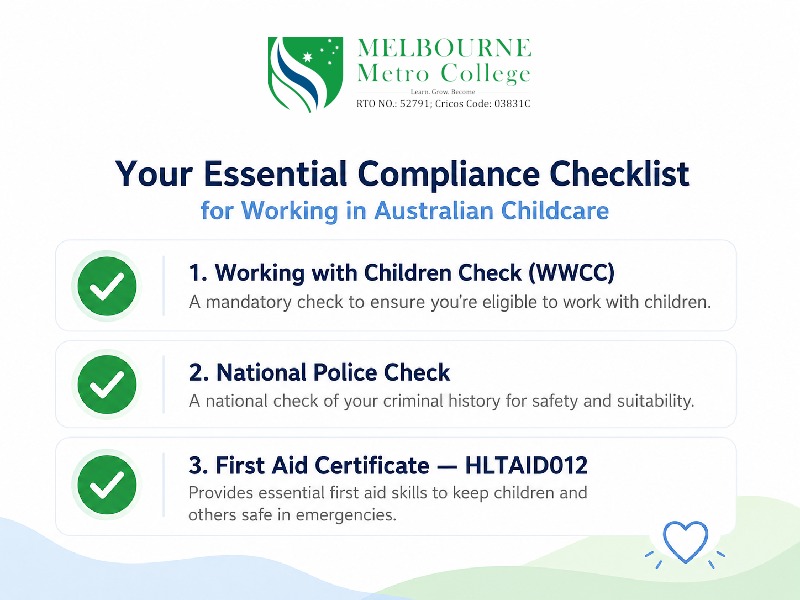
Before you can work with children in any regulated setting in Australia, three compliance requirements must be completed. These are legal requirements, not suggestions.
① Working with Children Check (WWCC)
Mandatory across every Australian state and territory. The name changes by location:
- Victoria, NSW, WA → Working with Children Check (WWCC)
- Queensland → Blue Card
- ACT → Working with Vulnerable People (WWVP) Check
Apply online through your state government authority. Allow several weeks for processing. Your WWCC is valid for a set period — typically 3 to 5 years depending on your state.
② National Police Check
Required by the vast majority of childcare employers. It verifies your criminal history at a national level. You can obtain one through the Australian Federal Police or an accredited third-party provider.
③ First Aid Certificate — HLTAID012
The required unit is HLTAID012 Provide First Aid in an Education and Care Setting. This single training package covers:
- CPR
- Standard first aid
- Asthma management
- Anaphylaxis response
Renewal schedule: CPR annually, First Aid every 3 years.
💡 Pro tip: Start your WWCC application early — before or at the same time as your enrolment. Processing delays can hold up your work placement if you leave it too late.
Step 5: Complete Your Supervised Work Placement
Work placement is where everything you have studied becomes real.
Both the Certificate III and Diploma include a mandatory supervised work placement component — hands-on time in an approved early childhood education and care setting, working directly with children under the guidance of an experienced educator.
During placement, you will:
- Plan and implement age-appropriate learning activities
- Support children through daily routines — meals, rest, transitions, outdoor play
- Observe and document children’s developmental progress
- Receive structured feedback from your workplace supervisor
- Demonstrate your understanding of child safety, health practices, and the NQF
Here is something placement students often discover: many receive job offers before they even finish their qualification. Treat every placement day like a working interview — because in many cases, it is.
Step 6: Apply for Jobs in Early Childhood Education
Qualified. Compliant. Placement complete. Now it is time to apply.
Common employers across Australia include:
- Large national operators: Goodstart Early Learning, Guardian Early Learning, G8 Education
- Local community-run childcare centres
- Government and private kindergartens and preschools
- Family day care services
- Outside school hours care (OSHC) providers
- Early intervention services for children with additional needs
Where to find jobs:
- State government education department portals
- Your RTO’s employment support services
Tailor your resume to highlight your qualification, compliance documents, work placement experience, and specific skills in play-based learning, child development, and family communication.
Step 7: Continue Your Professional Development
Gaining your qualification is the starting point — not the end goal.
The early childhood education sector expects ongoing professional development (PD) to stay current with regulatory changes, evolving practice standards, and children’s changing needs.
Ways to keep growing:
- Upgrade from Certificate III to Diploma
- Pursue a Bachelor of Early Childhood Education for teacher registration
- Take specialist courses in early intervention, inclusion support, or special education
- Engage with Early Childhood Australia (ECA) workshops and resources
- Work toward the role of Educational Leader within your service
- Progress to Centre Director or Service Manager
The National Quality Framework requires every approved childcare service to appoint an Educational Leader — a senior educator who drives professional learning across the team. This is a natural and achievable goal for Diploma-qualified educators.
How Long Does It Take to Become an Early Childhood Educator?
The honest answer: it depends on your starting point and how you study.
Qualification | Typical Duration |
Certificate III in Early Childhood Education and Care (CHC30125) | 6–18 months |
12–24 months | |
Bachelor of Early Childhood Education | ~4 years full time |
Graduate Diploma of Early Childhood Education | ~1 year (requires a prior bachelor’s degree) |
Three things that can shorten your study time:
- RPL (Recognition of Prior Learning): Existing relevant skills and experience can be formally assessed and credited toward your qualification — reducing both time and cost
- Credit transfer: Prior completed units from another qualification may be recognised
Full-time study: Completing units full time reduces your total study period compared to part-time enrolment
How Much Do Early Childhood Educators Earn in Australia?
Earnings in early childhood education vary based on your qualification level, your role, your employer, and your location.
Here is a general picture:
- Certificate III-qualified educators in entry-level positions earn at the lower end of the scale
- Diploma-qualified educators and room leaders typically earn more, reflecting their higher qualification and responsibility
- Registered early childhood teachers command the highest rates within the sector — consistent with their degree-level qualification and teacher registration
- Centre directors and educational leaders earn at the top of the sector’s pay scale
Factors that influence your earnings:
- Qualification level — Cert III vs Diploma vs Degree
- Years of experience in the sector
- Employer type — large national operator vs small community centre
- State or territory — cost of living differences apply
- Full time vs part time vs casual employment
For current and officially benchmarked salary rates, refer to the Fair Work Commission modern award for children’s services educators, or the Jobs and Skills Australia occupation profiles.
Pathways for Different Audiences

School Leavers
Finished Year 12 and ready to work with children? The Certificate III in Early Childhood Education and Care is your direct entry point.
You do not need an ATAR. You do not need prior work experience. You need a genuine interest in working with young children, willingness to complete work placement, and your compliance checks sorted early.
Many RTOs — including Melbourne Metro College — offer flexible timetabling so you can study while working part time.
Career Changers
Moving from another industry into early childhood education? Your life experience is more valuable than you think.
Skills from healthcare, retail, administration, community services, and even hospitality transfer meaningfully into early childhood settings. Patience, communication, problem-solving, and people skills are all directly relevant.
Steps for career changers:
- Speak to an RTO about RPL opportunities — your existing experience may credit toward your qualification
- Enrol in the Certificate III or Diploma depending on your background
- Complete your compliance checks while studying
- Use work placement to build sector-specific experience and connections
The sector actively welcomes mature-aged career changers. Diverse life experience strengthens early childhood teams.
Stay-at-Home Parents Re-entering the Workforce
Years spent raising children gives you genuine, applied knowledge of child development, behaviour guidance, and family communication. This is real experience — and RTOs recognise it.
RPL can formally credit that experience toward your qualification, reducing both your study time and costs.
Consider flexible study options — part time, online or blended delivery — and look into government-subsidised training available in Victoria and other states. The transition back into the workforce through a field you already know well makes strong practical sense.
Overseas-Trained Educators
If you trained as an early childhood educator or teacher in another country, your overseas qualification is not automatically recognised in Australia. Here is how to navigate it:
- Apply for an ACECQA skills assessment — they will compare your overseas qualification to the Australian standard
- ACECQA will advise whether you need additional study or can proceed directly to employment
- If qualification gaps exist, you may need to complete specific units or a full qualification through an Australian RTO
- Obtain all Australian compliance checks: WWCC, national police check, and HLTAID012 first aid
- If you are on a student visa, study at an approved CRICOS-registered institution — Melbourne Metro College holds CRICOS Code: 03831C
MMC provides dedicated international student support, including orientation, student advisory services, and connections to regional representatives across South Asia, Southeast Asia, the Middle East, and Africa.
Frequently Asked Questions
What qualifications do I need to work in childcare in Australia?
The minimum qualification is a Certificate III in Early Childhood Education and Care (CHC30125) — an ACECQA-approved qualification available through registered RTOs like Melbourne Metro College. Room leader and educational leader roles typically require a Diploma Of Early Childhood Education And Care (CHC50125). Registered early childhood teacher positions require a Bachelor of Early Childhood Education and state teacher registration.
What is the difference between an early childhood educator and an early childhood teacher?
An early childhood educator holds a Certificate III or Diploma and works in regulated childcare settings without needing teacher registration. An early childhood teacher (ECT) holds a Bachelor of Early Childhood Education, is registered with the state teacher registration authority, and takes on lead teacher and program leadership roles — particularly in kindergarten and preschool settings.
How long does it take to become an early childhood educator?
- Certificate III: 6–18 months
- Diploma: 12–24 months
- Bachelor (for teacher registration): approximately 4 years full time
Duration varies based on full-time vs part-time study and any RPL credits you receive for prior experience.
Do I need a degree to work in childcare?
No. A degree is not required to work as a qualified early childhood educator. The Certificate III in Early Childhood Education and Care (CHC30125) is the minimum qualification. A degree is only needed if you want to become a registered early childhood teacher.
What is the CHC30125 Certificate III?
The CHC30125 Certificate III in Early Childhood Education and Care is the nationally recognised, ACECQA-approved entry-level qualification for early childhood educators in Australia. It covers child development, play-based learning, health and safety, child protection, and family relationships. It is delivered by registered RTOs across Australia — including Melbourne Metro College in Melbourne’s CBD.
What checks do I need to work in childcare?
Three compliance checks are legally required:
- Working with Children Check (WWCC) — mandatory in all states and territories
- National Police Check — required by most employers
- First Aid Certificate (HLTAID012) — covering CPR, first aid, asthma, and anaphylaxis
All three must be current and valid before you work unsupervised with children in any regulated setting.
Can I study early childhood education online in Australia?
Yes — many RTOs and universities offer blended or online delivery for early childhood qualifications. However, the work placement component is always completed in person at an approved childcare or early learning setting. This cannot be substituted with online hours. Melbourne Metro College offers flexible study modes for both domestic and international students.
What is RPL and can it reduce my study time?
RPL (Recognition of Prior Learning) is a formal process where a registered RTO assesses your existing skills, knowledge, and real-world experience — and recognises these as equivalent to specific qualification units. If you have relevant work history, informal childcare experience, or life skills, RPL can meaningfully reduce your study time and overall qualification cost.
How much does an early childhood educator earn in Australia?
Earnings vary by qualification level, role, employer type, and location. Entry-level Certificate III educators earn at the lower end of the scale. Diploma-qualified educators and room leaders earn more. Registered early childhood teachers earn the highest rates within the sector. For current benchmarked rates, refer to the Fair Work Commission children’s services modern award.
Is there a shortage of early childhood educators in Australia?
Yes — and it is significant. Australia has a well-documented national shortage of qualified early childhood educators, driven by the Federal Government’s expanded Childcare Subsidy (CCS) program and growing demand for childcare places. Jobs and Skills Australia consistently lists early childhood educators and teachers among occupations facing national skills shortages — meaning qualified educators enter a market with strong, ongoing job demand.
Conclusion
The path to becoming an early childhood educator in Australia is clear, structured, and genuinely achievable — regardless of where you are starting from.
It begins with the right qualification. It continues with your compliance checks, your work placement, and a commitment to ongoing professional growth. And it leads to a career where the work you do every day has a direct, lasting impact on the children in your care.
Whether you are a school leaver, a career changer, a parent returning to the workforce, or an overseas-trained educator navigating Australian requirements — the pathway is the same. And the support is available.
In Melbourne, Melbourne Metro College is here to help you take that first step — and every step that follows.
📍 Level 5, 440 Elizabeth St, Melbourne VIC 3000 🌐 https://melmc.edu.au
Ready to start? Apply now at Melbourne Metro College and take the first step toward a career that shapes Australia’s next generation.
Melbourne Metro College is a Registered Training Organisation (RTO Code: 52791 | CRICOS Code: 03831C). All qualifications are nationally recognised under the Australian Qualifications Framework (AQF).